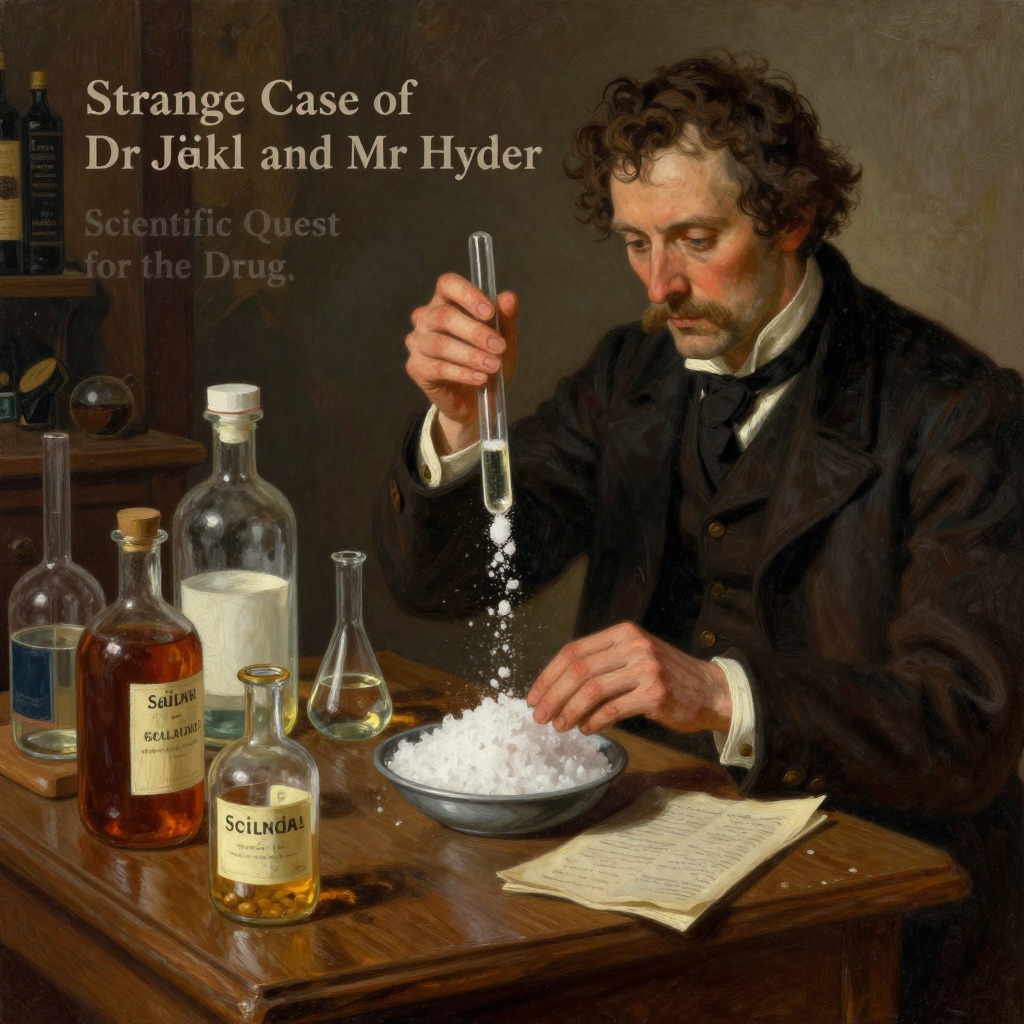
the laboratory building
The laboratory building at the bottom of Dr. Jekyll's garden is the architectural hinge of the novel's central mystery. Originally built for a celebrated surgeon and later converted by Jekyll to chemical purposes, this structure contains the cabinet where he compounds and consumes the transformative drug, the surgical theatre where he once lectured, and the by-street door through which Edward Hyde comes and goes. It is the place where Jekyll's respectable identity and Hyde's monstrous one meet, where the most terrible secrets are enacted, and where the story's final revelations occur.
Architecture and Layout
The building consists of two main levels. The ground floor is occupied by the surgical theatre, a large, gaunt, windowless space once crowded with eager students but now lying silent, its tables laden with chemical apparatus and its floor strewn with crates and packing straw. At one end of the theatre, a flight of stairs mounts to a door covered with red baize, which leads into the cabinet—Jekyll's private study and laboratory. The cabinet is a large room fitted with glass presses, furnished with a cheval-glass and a business table, and looks out upon the court by three dusty, iron-barred windows. A corridor joins the theatre to the by-street door, and the cabinet communicates separately with this corridor by a second flight of stairs. There are also a few dark closets and a spacious cellar filled with lumber dating from the surgeon's time.
The Cabinet as the Site of Transformation
The cabinet is the epicenter of Jekyll's double existence. It is here that he first compounds and drinks the transformative potion, experiencing the racking pangs that precede his metamorphosis into Edward Hyde. The cheval-glass, brought in later specifically for the purpose of observing these transformations, stands in the cabinet as a silent witness to the changes Jekyll undergoes. It is in this room that Jekyll keeps his drugs, and it is here that he must return after each of Hyde's excursions to drink the antidote and resume his own form. The cabinet becomes a prison as Jekyll's control over the transformations weakens; he increasingly confines himself to it, sometimes even sleeping there, and the servants hear the footsteps of the creature that now inhabits it pacing to and fro day and night.
The By-Street Door and Hyde's Access
The by-street door, which opens directly from the corridor into a busy quarter of London, is the means by which Hyde enters and leaves the building without being seen by Jekyll's household. It is equipped with neither bell nor knocker, and its panels are blistered and stained from years of neglect. Hyde possesses a key to this door, and it is through this entrance that he brings the child's family after the trampling incident, pays them with a cheque drawn in Jekyll's name, and later flees after murdering Sir Danvers Carew. The door becomes a symbol of the secret passage between Jekyll's two lives, and its key, found rusted and broken on the flags after Hyde's suicide, marks the final severance of that connection.
The Theatre as a Space of Witness and Violence
The surgical theatre, once a place of learning, becomes a space of dread and violence. It is here that Poole, searching for the drug Jekyll has been demanding, suddenly comes upon a masked figure—Hyde—digging among the crates. The creature gives a cry and whips upstairs into the cabinet, leaving Poole with the conviction that his master has been murdered. Later, when Utterson and Poole break into the cabinet, they find Hyde's body on the floor, the crushed phial in his hand, and the strong smell of kernels in the air. The theatre, with its lumber of crates and bottles, is the last place the two men search before they realize that Henry Jekyll has vanished.
Narrative and Thematic Significance
The laboratory building is more than a setting; it is a spatial embodiment of Jekyll's divided self. The respectable house in the square represents his public identity, while the laboratory, hidden at the bottom of the garden and accessible only through a back door, houses his secret, monstrous other. The building's architecture—the theatre where knowledge was once pursued, the cabinet where forbidden experiments are conducted, the by-street door that leads to the criminal underworld of Soho—maps the geography of Jekyll's moral and psychological fragmentation. It is the place where the boundaries between self and other, good and evil, life and death, are dissolved and remade, and where, in the end, the truth is finally uncovered.